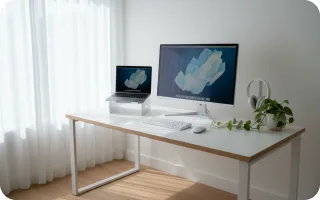

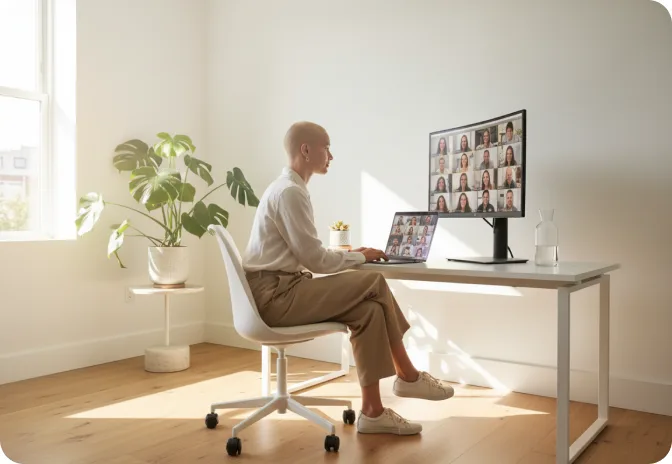
Remote work is no longer just about Slack channels and Zoom calls. It's about presence. In this guide, we'll explore how Zyra is bridging the gap between physical reality and digital collaboration.
Introduction to the Immersive Office
Zyra Virtual Office 2.0 rethinks the remote workspace as a place, not a link. Teammates move through shared rooms, bump into each other, and drop into conversations the way they would in a real building.
What a virtual office actually is
A virtual office is a shared digital space that stays open all day, where every teammate is represented by an avatar they can move around. Conversations start by walking up to someone rather than by sending an invitation. That single difference — presence instead of scheduling — is what separates a virtual office from a meeting tool, and it is the reason teams that adopt one stop booking a call for every two-minute question.
What changed in 2.0
Presence, not just messaging
The 2.0 release adds spatial audio, persistent rooms, and live avatars so distributed teams feel co-located — the passive serendipity of an office, delivered digitally.
Key upgrades for teams
- Spatial audio that fades with distance
- Persistent rooms your team can decorate
- Live avatars with status and reactions
- One-click screen share inside any room
How proximity audio works
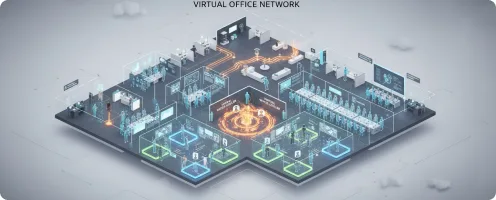
Proximity audio ties volume to distance. As your avatar moves toward a group their voices fade in, and as you walk away they fade out. Nobody mutes anyone and nobody joins anything, so the room behaves the way a physical room does: two people can talk in a corner while a third works nearby without being pulled in. It is the mechanic that makes an open shared space usable rather than deafening, and it is why a virtual office can hold a whole team at once where a single video call cannot.
Virtual office versus a video call
The difference is who decides
On a video call the calendar decides who talks to whom and when. In a virtual office the people do. That is why virtual offices are strongest for unscheduled work — pairing, quick reviews, the question you would have asked across a desk — and why most teams keep a meeting tool alongside one for anything scheduled or external.
Rolling it out
Start with one team and one daily ritual — a standup or a co-working block — then let adoption spread. Zyra spaces are self-serve, so no IT ticket is required to open a new room.
Setting up your first space
- One room per standing ritual — standup, co-working, retro
- A quiet zone where being present does not mean being interruptible
- One meeting room with a door people can close
- A social corner nobody is required to enter
- Room names that match how your team already talks about its work
Mistakes teams make in the first month
- Building an elaborate map before anyone has used a simple one
- Requiring people to be present all day, which turns presence into surveillance
- Leaving no quiet space, so focus work migrates back to chat
- Never agreeing what a status means, so nobody trusts the green dot
- Rolling it out to everyone at once instead of one team that wanted it
Who a virtual office is not for
If your team is genuinely asynchronous across many time zones and rarely overlaps, a persistent space will sit empty, and the thing you need is better writing rather than better presence. Virtual offices pay off where people already share several working hours and lose time scheduling the small conversations that fill them.
The road ahead
Toward the spatial web
Over the next few releases Zyra will blend physical and virtual presence even further, with mixed-reality entry points and calendar-aware rooms that assemble the right people automatically.